Free flow arts software for choreography, built on The Kinetic Alphabet
Flow Arts Composer is free flow arts software for building choreography in your browser. Construct a sequence step by step or generate one from parameters, then watch, save, export, and share the result. The Kinetic Alphabet keeps the notation attached to the movement.
Flow arts software is a digital tool made for planning, learning, recording, practicing, or presenting prop-based movement. The category includes lesson libraries, practice planners, video-effects apps, simulators, and composition tools.
Flow Arts Composer handles composition. Build a sequence, see its notation alongside the animation, keep it in a library, export it, or send someone a link they can open. The working demos throughout this page run the product itself. Features still in development stay in the roadmap below.
Pick a starting position and tap through the options. Each tap adds a step, and every step animates the moment you add it. You're never presented with an invalid option: the app tracks what's physically possible so you don't have to. You create, then approve or reject what you made.
Set the recipe and generate a sequence. The pictographs land one by one; press Play to put it in motion.
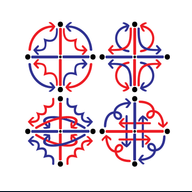
A mandala is the path a sequence traces. Change the movement and the shape changes with it, and the Kinetic Alphabet reaches shapes older systems couldn't hold.
Every sequence can unfold into a tunnel: the same choreography multiplied across two, four, or eight performers in a ring, with mirrors, echoes, and staggered canons on top. What starts as one pattern becomes a stage full of them. This is running live:
Choreo Cards put a sequence on a physical card: the word, every step, the mandalas, and a QR that opens it in Composer with any prop at any speed. Shuffle a deck and the game keeps going away from the app, one card in your hand at a time. Every card the app builds can print, and the decks in the shop are already composed and ready to spin.
Any sequence plays back in a full 3D scene: a performer spinning your choreography on a stage you can orbit. The one below is running live. Drag to look around, drop it into a different environment, or multiply it into a ring performing in unison. The 2D notation is the score. The 3D viewer is the performance.
Drag to orbit. Switch the scene, or multiply into a ring. This is the real viewer, running live.
The app ships with an arcade of games built from the alphabet: read pictographs, name words performed in front of you, match sequences to the mandalas they draw. The four that need no alphabet knowledge lead.
Follow the people whose flow you like. Their new sequences surface when you come back. The list ends. There is no infinite feed to scroll.
Browse everything the community has shared, filter it down, and drop what you like into a collection. Smart Collections fill themselves from a rule you set once.
Every one of these is live in the app today.
The Kinetic Alphabet exists on paper. It existed before this app, and it works without it: two pens and a notebook are enough to record choreography. Composer is an instrument built for that language. And like any instrument, you don't have to read the music to play it. The app handles the letters. You handle the movement.
The current notation model starts with double staves. Directly gripped static props such as fans, clubs, and buugeng can use the same structure. Momentum-based props, tosses, contact rolling, and grip changes are not covered as equivalent movements. A prop visual in Composer does not imply that the full movement model applies to that prop.
This is the app in miniature, running live. Swap effects, props, and tempo with the same controls the real thing gives you. The strip along the bottom is the sequence's notation, keeping time with the animation.