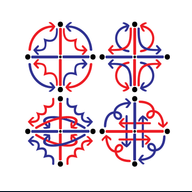
The base single-ended prop
This is dual-wielded club spinning: one club in each hand, held throughout the move. Clubs are the base prop of the single-ended family and central to Vulcan Tech Gospel, the framework The Kinetic Alphabet builds on. The history page traces that lineage.
To read a club pictograph, imagine the pinky end of a staff is invisible. The club's orientation follows the staff's thumb end. The grid, letters, and timing stay the same, as the player shows.
The two mandalas trace the identical sequence. In the staff render, both ends of each prop leave a path. In the club render, one does. On a staff, the thumb end isolates while the pinky end extends. A club can perform either path, so club spinners learn isolation and extension as separate moves with the same underlying geometry. A club's antispin reads as a vertical or a horizontal flower depending on its orientation through the pattern. VTG calls these vertical antispin and horizontal antispin. Both are visible at once on a staff.