The prop The Kinetic Alphabet was built for
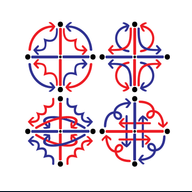
The Kinetic Alphabet began on paper with a red pen and a blue pen. A pen works like a small staff: each has two visible ends. For the first couple of years, sequences were built on a hand-drawn grid, with arrows drawn in the same two colors. Working sequences got their own pages.
A staff's straight shape is easy to draw without covering the arrows in a pictograph. Two staves placed end to end form one longer line, which makes their orientations easy to see on the grid.
Each staff has a thumb end and a pinky end. Hold the thumb end at center during an isolation and the pinky end performs an extension at the same time. A club has one visible end, so its isolation and extension are separate moves, despite sharing the same geometry. The club comparison shows the difference. A staff also covers both the vertical-flower and horizontal-flower antispin variants that VTG names for one-ended props.
A fan or club visibly points in one of eight directions. A staff radiating from center makes those eight orientations look like four. Orientation does not change the letter in a pictograph, so the reduced visual detail makes patterns easier to distinguish while learning.
Staff lessons keep the thumb and pinky ends as fixed references. The spinner uses the space above and below the shoulder, and turns into the plane behind the body, without finger spinning or changing grip. Other props use finger spins and grip changes, and the notation allows them.
When you're ready to learn the notation, the guide introduces every concept in order, the Double Staff Codex collects the pictographs themselves, and the Kinetic Atlas defines every term used on this page.
Flow Arts Composer is free to use. No download required.
Open Flow Arts Composer