Spin ratios
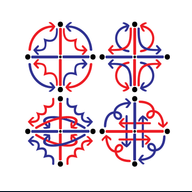
A spin ratio counts one pattern twice: how many circles the hand travels, and how many rotations the prop makes over the same span. It is written hands first, so 1:3 is one hand circle to three prop rotations. The Kinetic Alphabet counts the same motion as turns, where one turn is 180 degrees of prop rotation on top of the base rotation the motion already carries.
Three ratios carry most of the vocabulary. Lorq Nichols, who publishes as Spin Science(opens in a new tab), built the 144 Shape Matrix from 1:1, 1:3, and 1:5. The same construction keeps working the rest of the way up the turn ladder, which is what the tables below lay out.
Reading a ratio
- Hand cycles, H
- Complete circles the hand travels.
- Prop rotations, P
- Complete rotations the prop makes over those circles.
For a moving hand the two systems convert directly. Prop rotations per hand cycle are P / H = 2 × turns + 1, and the same relation read backwards is turns = (P / H − 1) / 2.
The reduced ratio also fixes the petal count. A prospin flower draws |P − H| petals and an antispin flower draws P + H. Both counts follow one end of the prop. A staff draws with both of its ends, and what the second end adds depends on the ratio, as One end or two lays out below.
Float sits outside the arithmetic. The prop makes no rotation of its own while the hand circles, which is the ratio 1:0, and the Kinetic Alphabet names it Float instead of a number.
Common names
- Cat-eye
- 1:1 antispin
- Triquetra
- 1:2 antispin
- 4-petal antispin flower
- 1:3 antispin
- 3-petal inspin flower
- 1:4 prospin
Each name describes the shape one end of the prop draws. Inspin is another name for prospin; Prospin and Inspin compares the two.
P is 3 and H is 1, so prospin draws 2 petals and antispin draws 4.
Ratios and turns
Every turn value the Kinetic Alphabet carries, set out by the level that first allows it. Each card gives the ratio, the turns it names, and the two flowers one hand draws at that ratio, following one end of the prop. A level keeps everything the levels before it allow and adds the cards under it.
Through Level 3 each ratio shows four flowers: prospin and antispin, each from a start with the prop pointing in and a start pointing out. At Level 1 those are four different base motions. From Level 2 on, the second start draws the first flower turned half a petal, so each flower is named by how it sits: a petal pointing up or down, petals stacked vertical or lying horizontal, four petals in diamond or box. At Level 4's quarter turns both starts draw the very same flower, so those cards show one, and every one of them puts a petal straight down, prospin and antispin alike.
Tinted cards are the three ratios of the original matrix.
1:1 Starts in
Prospin IsolationAntispin 2 petals, horizontal1:1 Starts out
Prospin ExtensionAntispin 2 petals, vertical
1:3 1 turn
Prospin Antispin 2 petals4 petals1:5 2 turns
Prospin Antispin 4 petals6 petals1:7 3 turns
Prospin Antispin 6 petals8 petals
Each whole turn adds two petals to both flowers, and a half turn adds one, so Level 3 fills the gaps between these counts.
1:0 Float
Holds one angle while the hand circles.1:2 0.5 turns
Prospin Antispin 1 petal3 petals1:4 1.5 turns
Prospin Antispin 3 petals5 petals1:6 2.5 turns
Prospin Antispin 5 petals7 petals
2:1 −0.25 turns
Prospin Antispin 1 petal3 petals2:3 0.25 turns
Prospin Antispin 1 petal5 petals2:5 0.75 turns
Prospin Antispin 3 petals7 petals2:7 1.25 turns
Prospin Antispin 5 petals9 petals2:9 1.75 turns
Prospin Antispin 7 petals11 petals2:11 2.25 turns
Prospin Antispin 9 petals13 petals2:13 2.75 turns
Prospin Antispin 11 petals15 petals
Quarter turns need two hand circles to bring the prop back, so they are written over 2. At 2:1 the prop turns slower than the hand: a quarter turn backwards.
Same petals, different laps
1:2 and 2:1 draw the same number of petals, one prospin and three antispin, yet they move nothing alike. Watch the hand, the solid dot on the dashed circle, and the prop, the line from it out to the blue end that draws.
At 1:2 the hand goes around once while the prop spins twice, and the drawing meets its start after that one lap. At 2:1 the prop turns once while the hand goes around twice, so the drawing laps the center twice before it closes. The 1:2 side finishes first and waits.
The petal count uses the two numbers together, |P − H| for prospin and P + H for antispin, so swapping them leaves it alone. The laps tell them apart: here the hand circle is wider than the prop's reach, so the drawing goes around the center once for every hand circle.
Every quarter turn ratio laps twice. That second lap is also why a staff draws nothing new there, as One end or two shows.
3 1:2 1 petal
- Hand cycles, H
- 0.0
- Prop rotations, P
- 0.0
Still drawing
4 2:1 1 petal
- Hand cycles, H
- 0.0
- Prop rotations, P
- 0.0
Still drawing
The original twelve
Nichols took four even petaled driving styles from each family, which gives twelve shapes for one hand. Three ratios, two spin directions, and two starting orientations reach the same twelve: prospin or antispin, started in or started out. A start pointing in puts the prop toward the center of the hand path, a start pointing out puts it away, and that choice moves where the figure sits.
The 1:1 prospin pair shows what the start does most plainly. Starting in holds the tracked end of the prop in one place, so it draws a point. Starting out carries that end around the whole hand circle. On a staff the two starts are the two ends of one prop, so the twelve fold into six.
- Prospin
- Prospin
- Antispin
- Antispin
- Prospin
- Prospin
- Antispin
- Antispin
- Prospin
- Prospin
- Antispin
- Antispin
One end or two
Every flower above follows one end of the prop. A poi or a club is held at one end and draws with the other, so that end is the whole drawing. A staff is held in the middle, spun alone or as double staff, and both of its ends draw.
The two ends of a staff point opposite ways, so when one starts in, the other starts out. A staff draws the in figure and the out figure at once: two one ended flowers become one staff flower that carries both.
Level 1 shows it most plainly. Prospin started in is an isolation, the end held in place as a point, and started out it is an extension around the big circle. On a staff they are one motion. The two antispin starts draw cat-eyes at right angles, and a staff draws both.
Through Level 3 every ratio takes one hand circle, and there the out figure is the in figure turned half a petal, so a staff doubles the petals. Level 4's quarter turns take two. After the first circle the prop is back where it began with its ends swapped, so the far end retraces the near end's path and nothing doubles. In and out draw the same figure there, which is why the Shape Engine fills its second quarter turn start with the prop pointing along the hand path instead.
1:1 Prospin
Starts inStarts outBoth ends1:1 Antispin
Starts inStarts outBoth ends
The isolation and the extension are one staff motion, and the two cat-eyes make a cross.
1:3 Prospin
Starts inStarts outBoth ends1:3 Antispin
Starts inStarts outBoth ends
Out is in turned half a petal, so each flower doubles.
1:2 Prospin
Starts inStarts outBoth ends1:2 Antispin
Starts inStarts outBoth ends
The same doubling at a half turn: 1 petal becomes 2, and 3 become 6.
2:3 Prospin
Starts inStarts outBoth ends2:3 Antispin
Starts inStarts outBoth ends
Two hand circles: the far end retraces the near end, so a staff draws what a poi draws.
The 144 pairings
One left hand shape over one right hand shape makes a cell. Twelve shapes on each axis is 144 cells, and that is the whole matrix at the three original ratios. Blue rows are the left hand and red columns are the right hand, so a cell shows both paths at once.
Choosing a cell opens that pairing in the Shape Engine, where it animates. With a keyboard, the arrow keys move between cells.
The grid is wider than this screen. Slide it sideways to reach every column.
Building flowers
Past the original twelve
The pairing does not stop at three ratios. Levels 3 and 4 bring in the half turn, quarter turn, and Float cards from the ladder above, and each hand picks its ratio on its own, so the two do not have to sit in the same family. Past the levels entirely, any two whole number ratios up to 15 on each side pair the same way.
Sources
- Lorq Nichols, 144 Shape Matrix, on Spin Science(opens in a new tab)
- The Vulcan Tech Gospel record
- The Lorq Nichols record
- Shape Engine
The Shape Engine was built independently by Austen Cloud. It does not reproduce Nichols' original diagram and is not an official Spin Science release.