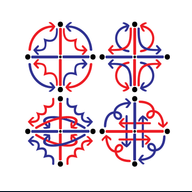
The priority order (Pro, Anti, Dash, Static) that determines which motion occupies the high (top) slot and which occupies the low (bottom) slot of a pictograph's turns column. When the two hands have different motion types, the higher-priority type goes in the high slot: pro beats anti beats dash beats static. For pro/anti hybrids (C, F, I, L, O, R, U, V) this means pro-high / anti-low. For Type 2 (W, X, Y, Z, Σ, Δ, θ, Ω): shift-high / static-low. For Type 3 (W-, X-, Y-, Z-, Σ-, Δ-, θ-, Ω-): shift-high / dash-low. For Type 4 (Φ, Ψ, Λ): dash-high / static-low. When motion types match, A, B, D, E, G, H, J, K, M, N, P, Q, dual-dashes (Φ-, Ψ-, Λ-), statics (α, β, Γ), left goes high and right goes low. S and T are the exception among matching-type hybrids: leading hand goes high, following hand goes low. The TKA software handles placement automatically. Defined in the Level 2 Guide (Glyphs / PADS section). Implemented implicitly in the codebase via per-letter-type branches in TurnColorInterpreter and TurnsTupleGenerator. No explicit PADS constant array exists.
- C-High-One: pro hand has 1 turn, anti hand has 0 (high = pro per PADS)
- R(fl, 0): float marker in high slot means the float was applied to the pro hand (pro-high / anti-low for hybrids)
- W(1, 0): shift has 1 turn, static has 0 (high = shift since shift beats static)
- Φ(1, 0): dash has 1 turn, static has 0 (high = dash since dash beats static)
- S-High-One: leading hand has 1 turn (leading goes high for S and T)