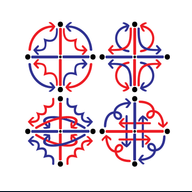
Every pattern here returns to where it started. There are exactly six ways to do it.
A LOOP is a sequence built to come back around: run it out, and the second half (or third, or fourth) answers the first under one of six transformations. Mirror it, flip it, swap the hands, invert the motions, rewind it, rotate it forward — or stack several at once. The chips below build any combination TKA has verified and show you a real example, worked out.
Toggle any combination the alphabet supports. Illegal combinations disable with the reason why. Every example on screen passed the same detector the app uses to classify a LOOP — nothing here is staged.
The picker composes transforms in one of two ways. A slash, as in Mirrored/Inverted, applies both simultaneously —
one compound operation. A plus, as in Swapped + Mirrored/Inverted, applies them in
order: build the inner pattern first, then transform the whole thing with the
outer one. Order matters — Swapped + Mirrored/Inverted and Mirrored/Inverted + Swapped are different
sequences, valid from different starting positions.
That constraint has a name: the fixed-point theorem. Say the inner pattern runs from position S back to S — that's what makes it circular on its own. The outer transform then has to take that closed loop and double it without breaking the seam, which means the outer transform has to leave S exactly where it is. The starting position has to be a fixed point of the outer transform.
| Transform | Fixed at |
|---|---|
| Mirrored | alpha1, alpha5, beta1, beta5 |
| Flipped | alpha3, alpha7, beta3, beta7 |
| Swapped | all beta |
| Rotated | none at L1-L4 |
| Inverted | all positions |
Rotated has no fixed point anywhere on the L1-L4 grid — every standard position moves when the pattern rotates 180 degrees. That's not a design choice; it's the reason rotation can never sit outermost. It only ever works as the innermost layer, the thing everything else gets built on top of.
Beta is the one position every transform agrees on: it's a fixed point for Swapped by construction (swapping two hands standing at the same spot changes nothing), and it overlaps Mirrored's and Flipped's fixed sets too. That overlap is what makes beta the position where the most compositions become legal — the universal connector between components.
| Composition | From | Result |
|---|---|---|
| Swapped + Mirrored/Inverted | alpha1 | Valid |
| Swapped + Flipped/Inverted | alpha1 | Blocked |
| Rotated + Swapped | alpha1 | Blocked |
| Rotated + Mirrored/Inverted | alpha1 | Valid |
| Mirrored/Inverted + Swapped | alpha1 | Blocked |
| Rotated + Swapped | beta3 | Valid |
| Mirrored/Inverted + Swapped | beta3 | Valid |
Length is a separate question from shape. A LOOP's position period is set by its outer transform — two passes for a halved rotation, four for a quartered one. But the props also carry an orientation, and orientation has its own period: every anti, dash, or hash motion flips it at the base, and turns step it further. If a hand's orientation hasn't cycled back to its start by the time the positions have, the LOOP keeps running extra passes until it does.
Realized length is the seed multiplied by the least common multiple of those two periods — position and orientation. That's why one LOOP type can render at two different lengths: same skeleton, but a seed heavy on anti and dash motions drifts in orientation even at zero turns, and needs more passes to close the loop than a plainer one does.
None of this is a new symmetry — mirror, flip, rotate, swap are old moves. What's unformalized is applying them to this particular movement space, and the orientation-period structure in particular: TKA hasn't found this worked out anywhere else.
Continuous Assembly Patterns are the poi community's answer to the same problem: a pattern that closes back on itself. The lineage runs through the Home of Poi forums and out into the wider community —
The two ideas overlap in what they're for but not in how they're built. A CAP composes per-hand trajectories — lay the left hand's path over the right hand's and see how they interlock. A LOOP composes per-beat snapshots — one letter already holds both hands, so the composition works on the whole picture at once, beat by beat. Parallel concepts, not one contained in the other. CAPs get their own full treatment on a dedicated page.
Every physical Choreo Card carries a small icon strip on its back, one glyph per active component. Once you know the six shapes, the strip tells you what the card does before you scan it.
A card carrying more than one icon is running them together, same rules as the
picker above — a strip reading Rotated and Mirrored is a Mirrored/Rotated LOOP, built the same way you just
built one.
Flow Arts Composer is free to use. No download required.
Open Flow Arts Composer