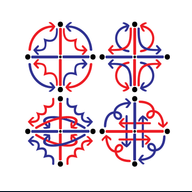
1-Turns

Shifts

VTG: 1:3

Turns: A turn is a 180° rotation that occurs during a motion. Let's add a single turn to a shift.

First we'll add 1 turn to a prospin. Take note of the diagonal halfway position, and pause there for a moment before continuing. These arrows refer to the pinky end on the first half, then to the thumb end on the second half. The full arrow depicts a half-circle, from the start position's outer point.

start
in
halfway
end
out

Prospin: the staff's spin matches its arc, so the turn and the shift from east to south blend into one curl

Each turn adds a thumb switch.

Pro: An isolation has 0 thumb switches, therefore a prospin with a turn has 1 thumb switch (in → out)

Now let's add 1 turn to an antispin. Again, take note of the diagonal halfway position, and pause there before continuing.

start
in
halfway
out
end
in

Antispin: the staff's spin fights its arc, curling back against the shift from east to south

Anti: A base antispin has 1 thumb switch. (in → out), therefore an antispin with a turn has 2 thumb switches (in → out → in).

Dashes

VTG: 1:1

You can also add a turn to a dash. During the prop rotation, move the hand directly in a straight line. Pause at the halfway point while learning to ensure that your hand is in the center point and the staff is perpendicular to your starting position.

start
in
halfway
end
in

The staff crosses straight through the center from south to north, flipping its thumb reference along the way

A base dash has 1 thumb switch (in → out), therefore a dash with a turn has 2 thumb switches (in → in).

Executing this move on repeat is commonly called a linear extension. It feels peculiar to execute with staves because one end is in pro and the other end is in anti. It helps to focus on the half that's in antispin. This will ensure that you pass your hand directly through the center point.

Static

Finally, we'll look at static turns. Here is a breakdown of a static turn starting from thumb in:

start
in
halfway
end
out

The staff never leaves east - only its thumb reference flips as it turns in place, in to out

This can be executed at any hand point, starting from either thumb orientation, turning in either direction.

Note the differences between the arrow for static turns and the arrow for prospin turns:

Static: Prop remains at its start position. The arrow forms a half circle with that position.

Shift: Prop ends at an adjacent position. The arrow forms a half-circle around the empty start position.

Glyphs / PADS

A glyph is a letter combined with other characters, such as numbers or symbols.

To the right of each letter, there are two slots: high and low. These slots contain numbers that indicate turns.

Update May 2025: TKA software now handles the placement of these numbers, so it's less important that you learn this. Don't sweat it. Focus on the motions.

In a hybrid, motion types are different and must be disambiguated. These rules indicate where to place numbers:

  • High: Pro, Anti, Dash
  • Low: Static

The motion that is higher on the list is indicated by the high slot. Remember the order with the acronym PADS, for Pro, Anti, Dash, Static.

The letters S and T have another factor, leading/following. In their case, leading is high and following is low.

There are five hybrids, each shown below in their corresponding high/low slots:

  • Type 1 Dual-Shift (Pro/Anti): C, F, I, L, O, R, U, V
  • Type 2 Shift (Leading/Following): S, T
  • Type 3 Cross-Shift (Shift/Static): W, X, Y, Z, Σ, Δ, Θ, Ω
  • Type 4 Dash (Shift/Dash): W-, X-, Y-, Z-, Σ-, Δ-, Θ-, Ω-
  • Type 5 (Dash/Static): Φ, Ψ, Λ

The remaining letters have combinations of the same motion type. For these, put left in the high slot and right in the low slot.

These letters include: A, B, D, E, G, H, J, K, M, N, P, Q, S, T, Φ-, Ψ-, α, β, Γ

Type 1: Dual-Shift (1-Turn)

When motion types are exactly the same, put left in the high slot and right in the low slot. Here is a breakdown of A¹ (pro|pro) and B¹ (anti|anti).

When motion types are different, high/low indicates how to label them. With hybrids, we can add a turn to either the pro or anti motion.

For pro/anti hybrids, high = prospin and low = antispin. This includes C, F, I, L, O, R, U, and V.

For code or file-naming, indicate turns with parentheses like so: C¹ = C(1,0) and C₁ = C(0,1)

S and T

S and T are a different type of hybrid. Even though their motions are a matching shift type (pro|pro, anti|anti), each has one hand leading and the other following. Though this doesn't affect their base forms, it produces additional variations when modifying their motions. S and T are the only letters that have a leader and follower while both hands share the same motion type.

Fortunately, we have a tool to disambiguate hybrids: the high/low slots. For S and T, high = leading and low = following.

start
in
halfway
end
mixed

S-High-One - both hands prospin; the leading hand carries the turn, the following hand only travels

start
in
halfway
end
mixed

S-Low-One - both hands prospin; the following hand carries the turn, the leading hand only travels

start
in
halfway
end
mixed

T-High-One - both hands antispin; the leading hand carries the turn, the following hand only travels

start
in
halfway
end
mixed

T-Low-One - both hands antispin; the following hand carries the turn, the leading hand only travels

Note that these leading/following rules do NOT apply to U and V. Even though U and V have a leader/follower, their slots refer to pro/anti.

Type 2: Shift (1-Turn)

Type 2 hybrids combine a shift and a static motion. These two motion types are different, so we use the high/low slots to differentiate them. To determine where they go, remember PADS. Because a shift (pro/anti) is higher than a static motion, we can confidently state that:

For Type 2, high = shift and low = static. This includes W, X, Y, Z, Σ, Δ, Θ, and Ω.

Type 2 motions become more complex when we add turns to the static hand. Since this causes both props to rotate, it creates either a Same or Opposite relationship. To indicate this, add a dot above or below the letter. A same-dot goes above and an opp-dot goes below.

You can also use (s) or (o) as parameters to indicate "same" or "opp". E.g. "W(s,0,1)"

Type 3: Cross-Shift (1-Turn)

Type 3 hybrids combine a shift with a dash. When we consult PADS, we find that a shift is higher than a dash, therefore:

For Type 3, high = shift and low = dash. This includes W-, X-, Y-, Z-, Σ-, Δ-, Θ-, and Ω-.

Take note of this strange position at the halfway point. There is a hand-to-end relationship between the left hand and the right staff's pinky end. It is important to pass through this position for the timing to be accurate.

Now let's add 1 turn to the dash, leaving the shifting hand unmodified. This creates a rotational relationship, so we'll need to use Same-dots and Opp-dots.

The halfway position holds the key for executing cross-shifts with accurate timing. Though unfamiliar now, these centric positions will be thoroughly deconstructed later on.

When writing code, put the dash after the letter and before the parentheses. E.g. Z-(s,0,1)

Type 4: Dash (1-Turn)

Type 4 hybrids combine a dash with a static motion. There is no shift involved. According to PADS, a dash is higher than a static motion.

For Type 4, high = dash and low = static. This includes Φ, Ψ, and Λ.

When typing the words for sequences containing greek symbols, it's easier to just type the word or its first three letters. E.g. "phi(0,1)". The corresponding symbol can easily be swapped in with a simple script. The short versions of the seven greek letters are "sig, del, the, om, phi, psi, lam"

Opening / Closing

Because of Gamma's asymmetry, Λ (Lam) presents an extra variation when adding a turn. We can't use rotational relationship to tell them apart, because there isn't one to describe. Instead, we can disambiguate them with opening and closing. This refers to the appearance of the 90° angle if we continue the rotation into a pro-shift.

start
in
halfway
end
in

Opening - the dashing hand carries the turn; its spin resolves toward alpha, hands finishing apart

start
in
halfway
end
in

Closing - the dashing hand carries the turn; its spin resolves toward beta, hands finishing together

Now let's add 1 turn to the static hand, leaving the dash in its base form. Since the dashing prop is not rotating, there is no rotational relationship to describe. However the rotating static prop can still be identified as opening or closing.

start
in
halfway
end
out

Opening - the static hand carries the turn this time; its spin resolves toward alpha, hands finishing apart

start
in
halfway
end
out

Closing - the static hand carries the turn this time; its spin resolves toward beta, hands finishing together

It's not necessary to speak all of the glyph modifications when talking about a letter. It would be cumbersome if you were required to say "Lam-Low-One-Closing". In the context of a word or sequence, you can just refer to the base letter "Lam" instead.

To shorten this for code, include "op" or "cl" as a final parameter. E.g. "(0,1,op)" or "(0,1,cl)"

Type 5: Dual-Dash (1-Turn)

In Type 5 motions, both hands are dashing, so there are no hybrids. Since they're the same type (dash|dash), the left goes in the high slot, and the right goes in the low slot.

This includes Φ-, Ψ-, and Λ-.

Remember, the high/low slots do not refer to left/right. Instead, their purpose is to differentiate two motion types. In Type 5, those motion types are the same (dash|dash).

As always, pause at the halfway point to drill it into your muscle memory. This will ensure proper timing.

Type 6: Static (1-Turn)

Finally, Type 6 letters have both hands remaining static. Both types are the same (static|static), so the number goes in the high slot by default.

This includes α, β, and Γ.

Note that the arrow can follow the path of either the thumb end or pinky end. The optimal placement depends on context.

These static single-turns are relatively simple. Next we'll look at dual-turns, in which both props are receiving a turn.

1|1 Turns

For a turn on both props, add a "1" in both the high and the low slot. This can also be written as 1|1. Here are some cherry-picked examples of 1|1 in each Type. Since you know all the mechanisms involved, explanation is kept to a minimum.

Type 1

Pause at the halfway point of each motion while learning. This will ensure accurate timing.

start
in
halfway
end
out

D-One-One - both hands prospin together, watch them turn in sync, ending with thumbs out

start
in
halfway
end
mixed

I-One-One - one hand prospins while the other antispins at the same time, ending with mixed thumb references

start
in
halfway
out
end
in

N-One-One - both hands antispin together, watch them turn in sync, ending with thumbs in

start
in
halfway
end
mixed

V-One-One - one hand antispins while the other prospins at the same time, ending with mixed thumb references

Type 2

Type 3

Type 4

Type 5

Type 6