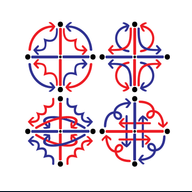
1-Turns: Types 1–6
Type 1: Dual-Shift (1-Turn)
When motion types are exactly the same, put left in the high slot and right in the low slot. Here is a breakdown of A¹ (pro|pro) and B¹ (anti|anti).
When motion types are different, high/low indicates how to label them. With hybrids, we can add a turn to either the pro or anti motion.
For pro/anti hybrids, high = prospin and low = antispin. This includes C, F, I, L, O, R, U, and V.
For code or file-naming, indicate turns with parentheses like so: C¹ = C(1,0) and C₁ = C(0,1)
Type 2: Shift (1-Turn)
Type 2 hybrids combine a shift and a static motion. These two motion types are different, so we use the high/low slots to differentiate them. To determine where they go, remember PADS. Because a shift (pro/anti) is higher than a static motion, we can confidently state that:
For Type 2, high = shift and low = static. This includes W, X, Y, Z, Σ, Δ, Θ, and Ω.
Type 2 motions become more complex when we add turns to the static hand. Since this causes both props to rotate, it creates either a Same or Opposite relationship. To indicate this, add a dot above or below the letter. A same-dot goes above and an opp-dot goes below.
You can also use (s) or (o) as parameters to indicate "same" or "opp". E.g. "W(s,0,1)"
Type 3: Cross-Shift (1-Turn)
Type 3 hybrids combine a shift with a dash. When we consult PADS, we find that a shift is higher than a dash, therefore:
For Type 3, high = shift and low = dash. This includes W-, X-, Y-, Z-, Σ-, Δ-, Θ-, and Ω-.
Take note of this strange position at the halfway point. There is a hand-to-end relationship between the left hand and the right staff's pinky end. It is important to pass through this position for the timing to be accurate.
Now let's add 1 turn to the dash, leaving the shifting hand unmodified. This creates a rotational relationship, so we'll need to use Same-dots and Opp-dots.
The halfway position holds the key for executing cross-shifts with accurate timing. Though unfamiliar now, these centric positions will be thoroughly deconstructed later on.
When writing code, put the dash after the letter and before the parentheses. E.g. Z-(s,0,1)
Type 4: Dash (1-Turn)
Type 4 hybrids combine a dash with a static motion. There is no shift involved. According to PADS, a dash is higher than a static motion.
For Type 4, high = dash and low = static. This includes Φ, Ψ, and Λ.
When typing the words for sequences containing greek symbols, it's easier to just type the word or its first three letters. E.g. "phi(0,1)". The corresponding symbol can easily be swapped in with a simple script. The short versions of the seven greek letters are "sig, del, the, om, phi, psi, lam"
Type 5: Dual-Dash (1-Turn)
In Type 5 motions, both hands are dashing, so there are no hybrids. Since they're the same type (dash|dash), the left goes in the high slot, and the right goes in the low slot.
This includes Φ-, Ψ-, and Λ-.
Remember, the high/low slots do not refer to left/right. Instead, their purpose is to differentiate two motion types. In Type 5, those motion types are the same (dash|dash).
As always, pause at the halfway point to drill it into your muscle memory. This will ensure proper timing.
Type 6: Static (1-Turn)
Finally, Type 6 letters have both hands remaining static. Both types are the same (static|static), so the number goes in the high slot by default.
This includes α, β, and Γ.
Note that the arrow can follow the path of either the thumb end or pinky end. The optimal placement depends on context.
These static single-turns are relatively simple. Next we'll look at dual-turns, in which both props are receiving a turn.